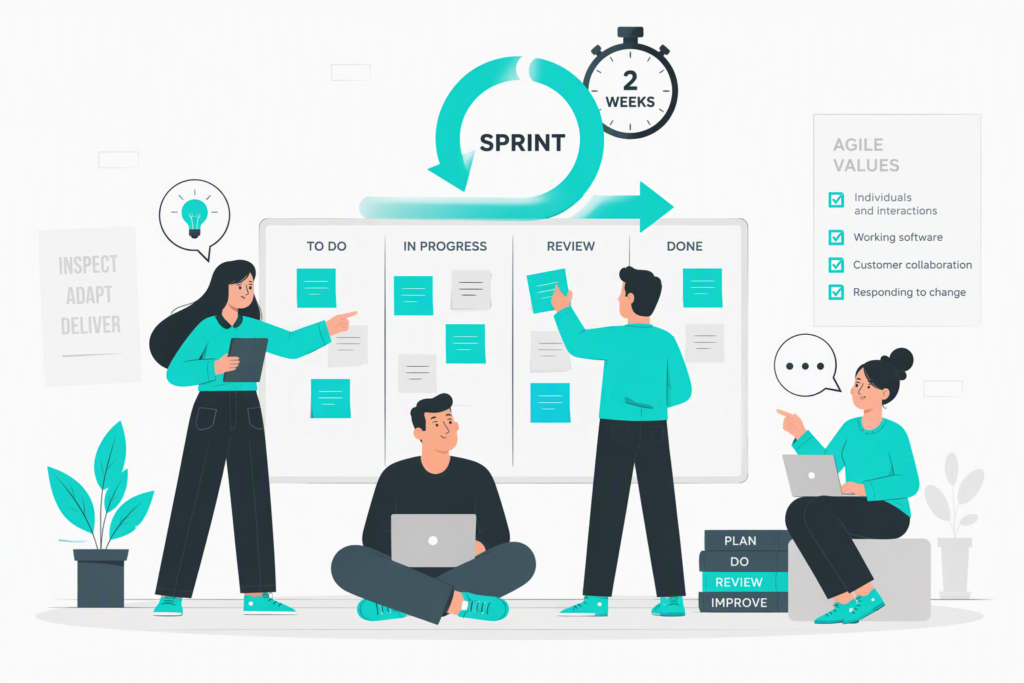

Welcome to our Sprint Reflections
Every two weeks, our team comes together for our sprint review and planning sessions. I’ve realised that many of the conversations, lessons and achievements shared on those days never make it much further than the room. Yet they’re often the most interesting part of my week.
Digital delivery can sometimes look simple from the outside. A new website page appears, a form gets improved, an accessibility issue gets fixed, or a service launches. What isn’t always visible is the collaboration, problem-solving, research, prioritisation, and decision-making that happens behind the scenes to make it possible.
Our sprint days are an opportunity to step back from the day-to-day. As a team, we review what we’ve delivered, demonstrate completed work, discuss challenges, celebrate successes, look at internal and external feedback, and plan where we’ll focus our efforts next. As a product lead, I’m happy to admit that I do not always get it right, so it is essential we get together as a team and have an open conversation.
So I’m going to start writing a short blog after each sprint. Nothing too long, just a quick reflection on what we’ve been working on, what we’ve learned, what’s changed, and where we’re focusing our attention next.
If you’re curious about how digital transformation happens in practice, I hope you’ll enjoy following along.
Sprint 66 review, retrospective and planning summary
The team reviewed delivery across content, forms, platform improvements and operational support. Despite reduced capacity in some areas, significant progress was made on content simplification, forms delivery, automation and technical improvements.
The team also agreed on priorities for the next sprint, with a focus on completing key migration work, progressing forms consolidation and building knowledge across the team.
What was covered
Key achievements included the launch of a Report flooding form, the rebuild of multiple forms for the forms migration work, and significant content simplification work. The Cost of living support in Somerset section was streamlined into a clearer structure, while the Somerset Graduated Response Framework was reduced from 33 pages to 22, making information easier for residents to find and use.
Technical improvements included centralised website monitoring, automated security updates, and enhancements to release and notification processes. Automation also continued to deliver benefits, with 174 items processed automatically during September.
Microsite and Content Migration Planning: The team reviewed progress on Somerset Prepared, council tax recovery content, professional choices migration work, and Healthy Somerset updates. Actions included continuing content migration, reducing duplication, resolving navigation and branding items, and preparing future launches.
Planning discussions focused on future priorities, including forms consolidation, content migration, homepage and navigation improvements, and exploring opportunities for AI-assisted search. The team also agreed to increase knowledge-sharing through workshops and learning sessions to build capability and reduce reliance on individual specialists.
For the next sprint, priorities include progressing licensing-related form rebuilds, completing remaining flooding form updates where data is available, continuing content migration work, gathering feedback on recently simplified content, and developing ideas for future website user experience improvements.
Highlights
Content Designer rollout
The Content Designer page template allows you to make a normal content page with a left-side navigation column, with the addition of support for designed elements such as columns and banners.
This template should be used sparingly, rather than design for design’s sake.
It is most useful for areas such as Local Offer pathways which contain complex information that benefits from being broken down into smaller chunks visually.
The team reviewed the new Content Designer capability, including:
- multi-column layouts
- banners
- pathways
- icons
- images
- enhanced page design options
The agreed approach is to:
- use new features where they improve understanding
- maintain accessibility standards, including alt text
- peer review early implementations
- avoid unnecessary complexity
Homepage and user experience
The team discussed future opportunities for:
- task-focused navigation
- improved content discovery
- homepage redesign concepts
- AI-assisted search and support
The next step is to gather ideas, research and examples ahead of a future workshop.
Challenges
Directory and Forms Support: The Development officers discussed challenges with directory configuration and templates while reviewing updates to consultation-related forms and service requests. The team agreed to clarify directory standards and improve knowledge sharing to avoid future setup confusion.
Sprint Review and BAU Support: It was explained that much of the sprint was spent balancing planned work with increased BAU activity due to team absences. Page title improvements reduced identified issues from just over 100 to around 80, and the team agreed to capture clearer performance metrics and continue reducing outstanding issues.
Next sprint priorities
- Continue licensing-related form rebuilds and progress forms consolidation activity
- Complete outstanding flooding form updates where dependencies are resolved
- Gather feedback on recently simplified content and continue migration work
- Reduce content duplication and improve navigation across key services
- Develop ideas and evidence to support future website user experience and homepage improvements